Primary & Secondary Program

Give Your Child a Glimpse of living in Australia

Before they decide where to go in life… let them experience what’s possible.

Australian Curriculum
Always Underrated

For many parents, British curriculum is one of the first international curricula that comes to mind. The Australian education system offers a different approach, with a strong emphasis on both subject knowledge and the development of skills and capabilities.

The central idea is: what students learn matters, but so does what they can do with that knowledge.

What Is the Australian Curriculum?

The Australian Curriculum provides a national framework describing what students should learn throughout their schooling. It is organised around three connected dimensions.

1. Learning Areas

These provide the foundation of academic learning:
– English
– Mathematics
– Science
– Humanities and Social Sciences
– Health and Physical Education
– The Arts
– Technologies
– Languages

Each learning area sets out the knowledge, understanding and skills students are expected to develop.

2. General Capabilities

The curriculum also develops capabilities across different subjects:

– Literacy
– Numeracy
– Critical and Creative Thinking
– Digital Literacy
– Personal and Social Capability
– Ethical Understanding
– Intercultural Understanding

These capabilities are developed through classroom learning rather than as separate subjects.

3. Cross-Curriculum Priorities

Learning also incorporates three broader priorities:

– Histories and Cultures
– Asia and Australia’s Engagement with Asia
– Sustainability

These are integrated where relevant across learning areas.

Beyond Learning Facts

The Australian Curriculum is designed to develop knowledge alongside the ability to use it.

A student studying Science, for example, may learn scientific concepts while also learning to question, investigate, analyse, communicate and reflect.

This approach connects academic learning with problem-solving, communication, critical thinking and application.

What This Means in Western Australia

For families considering Western Australian schools, an important distinction is that schools operate within the Western Australian Curriculum and Assessment Outline, administered by the School Curriculum and Standards Authority (SCSA).

Western Australia incorporates and adapts elements of the Australian Curriculum within its own curriculum framework and requirements. The WA framework therefore provides the specific context for teaching, learning and assessment in Western Australian schools.

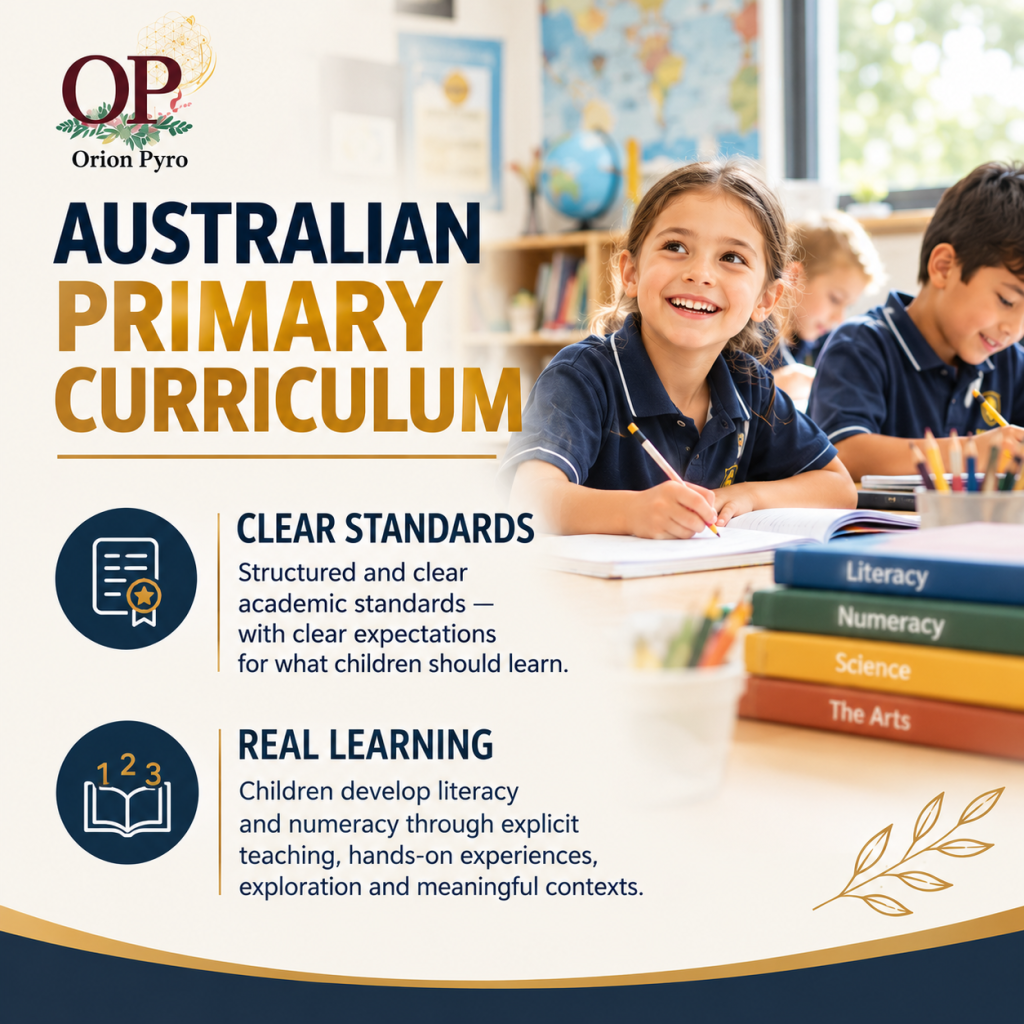
For parents, this means students follow clear curriculum content and achievement standards while also developing capabilities through their learning.


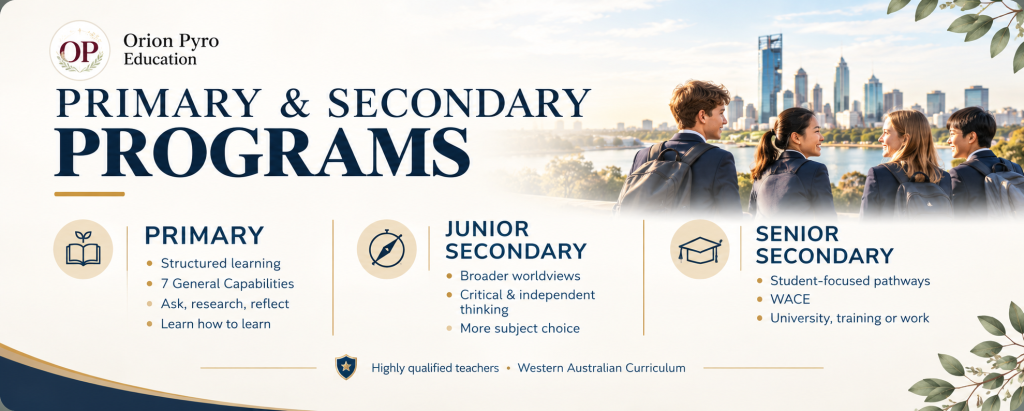
From Primary to Senior Secondary

Primary school establishes foundations in literacy, numeracy and core knowledge, while developing communication, curiosity and independent learning.

Junior secondary broadens students’ subject knowledge and perspectives, with increasing emphasis on independence, critical thinking and informed choices.

Senior secondary gives students greater scope to shape their studies around their interests and future pathways, including university, further training and employment.

A Different Way of Thinking About Education

The Australian approach does not separate academic knowledge from the skills needed to use it.

It asks students not only to understand ideas, but increasingly to apply, question, analyse, communicate and create.

For parents considering different education systems, that distinction is worth understanding.

International School
Students Testimonial
Alan Qian
Alan Qian
Year 8 Immersion Student
"Alan really enjoyed studying at Swan Valley Anglican Community School. Firstly, the school offers a diverse and enriching curriculum, including sewing and cooking classes. These courses are essential for children to develop practical life skills and grow as individuals. Secondly, the teachers and classmates are exceptionally friendly. Teachers show great respect for students, and the children are kind and welcoming to one another, especially toward new students. This creates a warm and inclusive atmosphere." ~ Swan Valley Anglican Community School ~
Joseph Li
Joseph Li
Yr 5 Immersion Student
"Thank you for welcoming and supporting international students like me. Your care has helped me feel safe, included, and confident in a new place. What you do means so much; you not only helped us settle in but also shaped my future. I’m truly grateful to be part of this amazing community." ~ Peter Moyes Anglican Community School ~
Quang Phat (Patrick) Ngo
PSS Student
"I want to find a better future for myself. That’s why I decided to study abroad. If you intend to study abroad, but your English is not good, you can set aside more time to learn, and, if you are not feeling confident, you can always come and experience. After one or two months, your English will improve significantly. When I studied in the Language College, I made friends from other countries and I felt confident when I did something new, like presentations." ~ Language College ~